
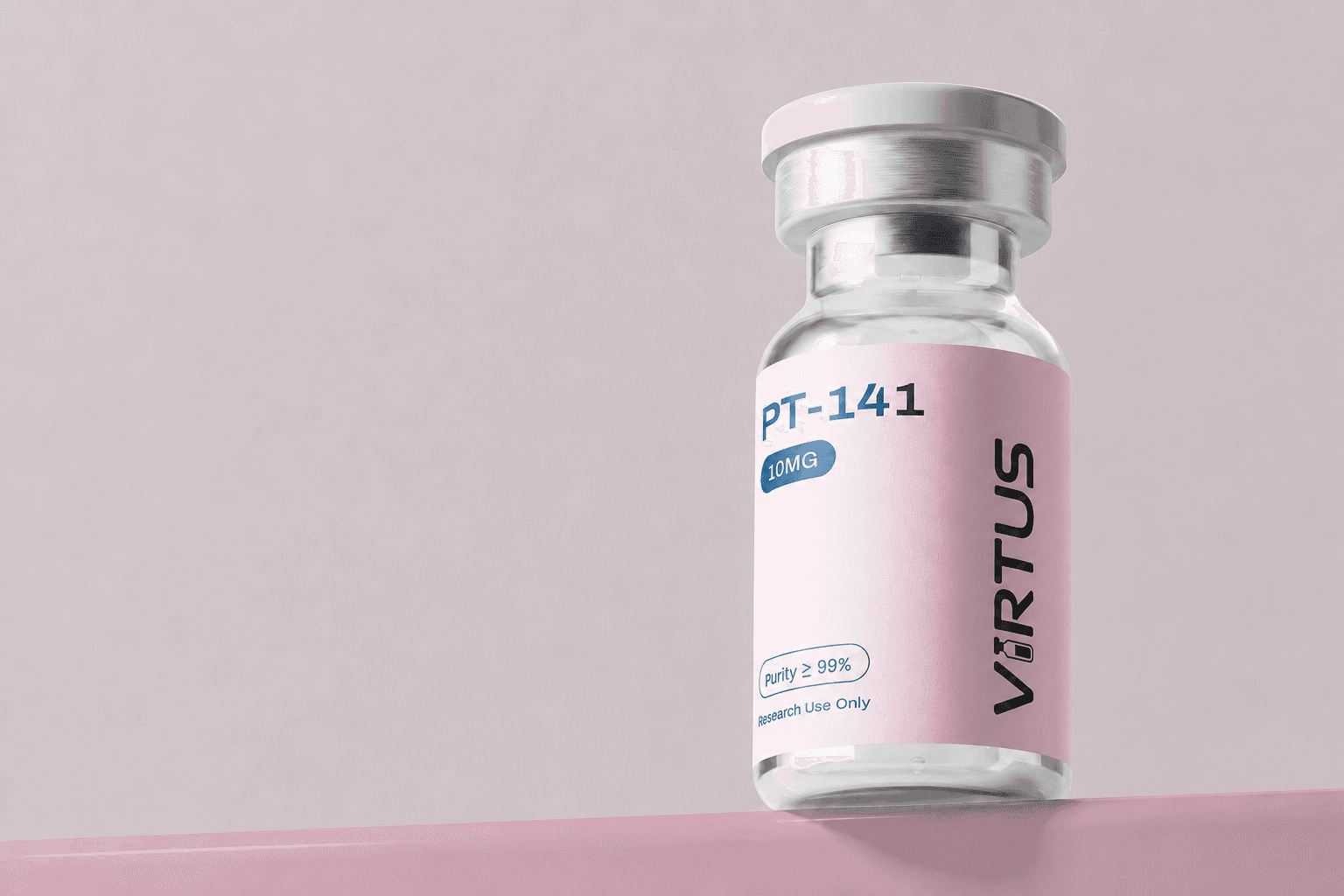
PT-141
Melanocortin Receptor Agonist Peptide
Also referenced as: Bremelanotide · PT-141 · Ac-Nle-cyclo[Asp-His-D-Phe-Arg-Trp-Lys]-OH · Melanocortin Receptor Agonist
≥99% Purity Guaranteed
Full Panel COA
UPS 2-Day Air Shipping
Shipment InsuredShipment Insurance Included
Lab Results
| Test | Result | Status |
|---|---|---|
| Purity | – | Pending |
| Quantitation (Avg) | – | Pending |
| Heavy Metals (ICP-MS) | – | Pending |
| Endotoxin (USP <85>) | – | Pending |
| Sterility (PCR) | – | Pending |
| Multi Vial Tested | – | Pending |
Made in cGMP- and ISO-certified facilities vetted by our established North American supply partner. Virtus tracks the factory batch number on every lot and catalogues it against independent lab testing, with a final Certificate of Analysis from ILS Laboratories. We pay more to source this way because we hold the highest standard for the product and for you.
Curated research on PT-141
Molinoff PB (2003). PT-141: a melanocortin agonist for the treatment of sexual dysfunction Ann N Y Acad Sci.
PMID: 12851303 →Diamond LE (2006). An effect on the subjective sexual response in premenopausal women with sexual arousal disorder by bremelanotide (PT-141), a melanocortin receptor agonist J Sex Med.
PMID: 16839319 →
About PT-141
A cyclic heptapeptide analogue of α-melanocyte-stimulating hormone (α-MSH) investigated in preclinical research as a non-selective melanocortin receptor agonist. PT-141 is studied in receptor-pharmacology and animal-model work for its engagement of the melanocortin system, principally MC4R and MC3R, and the central signaling pathways associated with those receptors.
Derived from the melanotan II scaffold with a D-Phe substitution and an Asp–Lys lactam bridge that confer metabolic stability in laboratory assays, PT-141 (bremelanotide) is examined in published literature as a tool compound for probing melanocortin receptor selectivity, cAMP / Gs signaling, and hypothalamic melanocortin circuitry at the cellular level.
Also Referenced As
Bremelanotide · PT-141 · Ac-Nle-cyclo[Asp-His-D-Phe-Arg-Trp-Lys]-OH · Melanocortin Receptor Agonist
Specifications
- Scientific Name
- PT-141: Bremelanotide (Melanocortin Receptor Agonist)
- CAS Number
- 189691-06-3
- Molecular Formula
- C₅₀H₆₈N₁₄O₁₀
- Molecular Weight
- 1,025.2 g/mol
- Physical Form
- Lyophilized powder
- Purity
- Coming Soon
- Batch Number
- TBD
- Storage
- −20°C, protected from light, avoid repeated freeze-thaw cycles
Storage & Handling
Lyophilized peptides remain stable for 12–24 months when stored properly. Follow standard laboratory protocols for handling.
Storage
Store lyophilized peptide at −20°C in a standard laboratory freezer, protected from light, moisture, and heat. Avoid repeated freeze-thaw cycles.
Shelf Life
Lyophilized form remains stable for 12–24 months at −20°C in the original sealed vial. Always reference the batch-specific COA for verified shelf-life data.
Mechanism & Research Background
PT-141 (bremelanotide) is a synthetic cyclic heptapeptide analogue of α-MSH with the structure Ac-Nle-cyclo[Asp-His-D-Phe-Arg-Trp-Lys]-OH. In receptor-binding studies it behaves as a non-selective melanocortin receptor agonist, with highest reported affinity for MC4R and MC3R, intermediate activity at MC1R, and negligible activity at MC5R and MC2R. The D-Phe substitution and Asp–Lys lactam bridge are described in the literature as conferring resistance to enzymatic degradation in preclinical assays.
In cell-culture systems, melanocortin receptor engagement by PT-141 couples to Gs / adenylyl-cyclase / cAMP signaling, with Gq-linked phospholipase-C / Ca²⁺ and ERK / MAPK cascades also reported for MC4R. Published research uses the peptide as a reference melanocortin ligand for receptor-selectivity and signaling-pathway profiling, and as a centrally acting probe of hypothalamic melanocortin circuitry in animal models, distinct from peripheral vascular mechanisms.
MC4R is documented in rodent models as a regulator of energy homeostasis and appetite / satiety signaling, and PT-141 has been studied in this context as a melanocortin-pathway tool compound. The peptide is reported in preclinical literature to cross the blood–brain barrier, which has made it of interest for distinguishing central from peripheral melanocortin signaling. PT-141 remains a research-stage molecule; products supplied by Virtus Peptides are intended exclusively for in-vitro laboratory research and are not for human or animal use.