
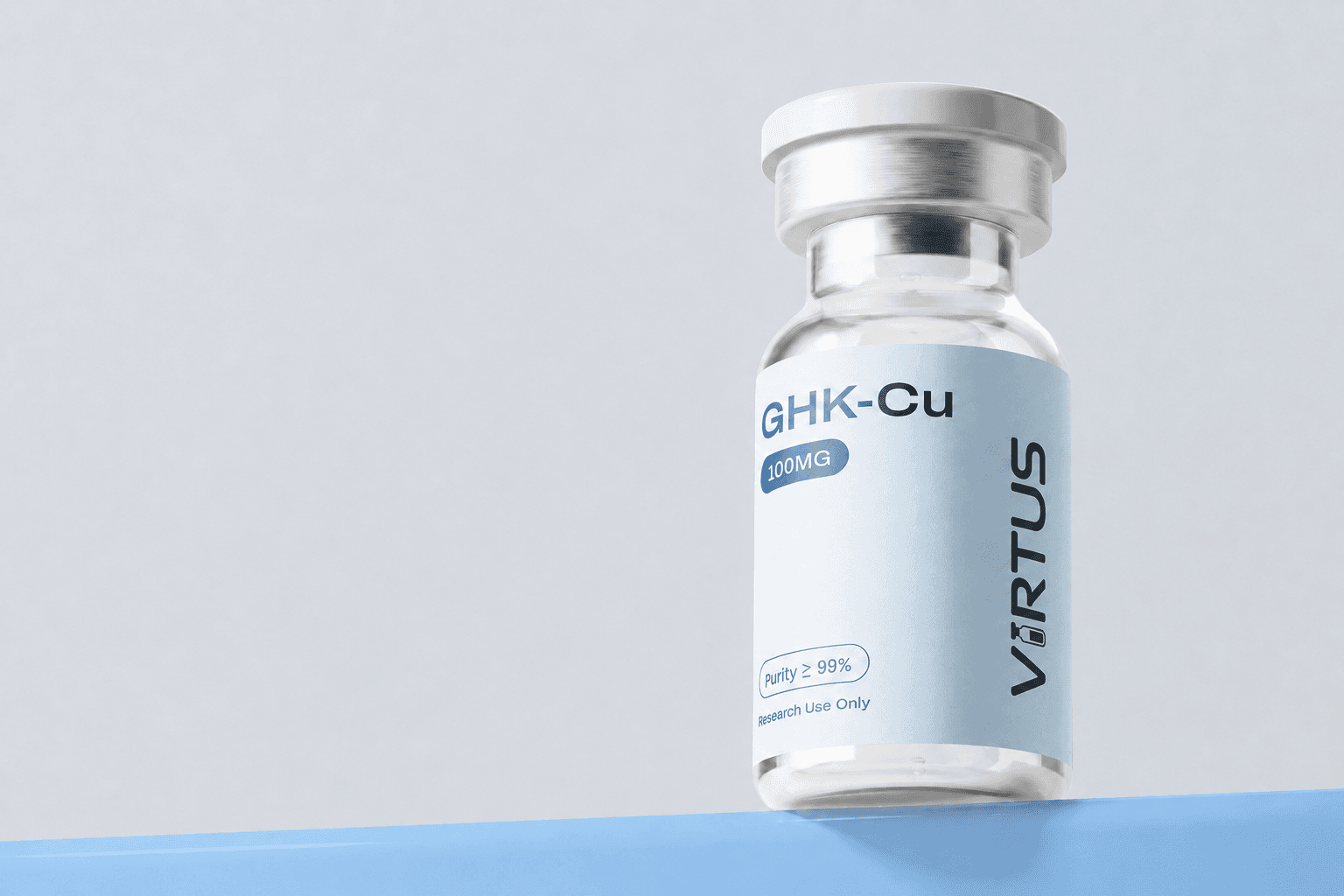
GHK-Cu
Glycyl‑L‑Histidyl‑L‑Lysine Copper Complex
Also referenced as: Glycyl-L-Histidyl-L-Lysine Copper Complex · GHK Tripeptide Copper(II) · Cu(II)-GHK · Copper Peptide GHK
≥99% Purity Guaranteed
Full Panel COA
UPS 2-Day Air Shipping
Shipment InsuredShipment Insurance Included
Lab Results
| Test | Result | Status |
|---|---|---|
| Purity | Pending | Pending |
| Quantitation (Avg) | Pending | Pending |
| Heavy Metals (ICP-MS) | Pending | Pending |
| Endotoxin (USP <85>) | Pending | Pending |
| Sterility (PCR) | Pending | Pending |
| Multi Vial Tested | Pending | Pending |
Made in cGMP- and ISO-certified facilities vetted by our established North American supply partner. Virtus tracks the factory batch number on every lot and catalogues it against independent lab testing, with a final Certificate of Analysis from ILS Laboratories. We pay more to source this way because we hold the highest standard for the product and for you.
Curated research on GHK-Cu
Pickart L (2018). Regenerative and Protective Actions of the GHK-Cu Peptide in the Light of the New Gene Data Int J Mol Sci.
PMID: 29986520 →Pickart L (2015). GHK Peptide as a Natural Modulator of Multiple Cellular Pathways in Skin Regeneration Biomed Res Int.
PMID: 26236730 →Pickart L (2012). The human tripeptide GHK-Cu in prevention of oxidative stress and degenerative conditions of aging: implications for cognitive health Oxid Med Cell Longev.
PMID: 22666519 →Pickart L (2017). The Effect of the Human Peptide GHK on Gene Expression Relevant to Nervous System Function and Cognitive Decline Brain Sci.
PMID: 28208777 →
About GHK-Cu
A naturally occurring copper-binding tripeptide composed of glycine, histidine, and lysine studied extensively in controlled laboratory environments. Investigated in peer-reviewed preclinical research for its role in cellular signaling, metal-ion interaction pathways, extracellular matrix modeling, and gene expression studies.
GHK-Cu interacts with extracellular matrix components, transcriptional regulators, and membrane-associated proteins in laboratory models. Research has examined its influence on transcriptional networks associated with cellular migration, extracellular matrix turnover, and redox balance pathways. One of the most referenced peptides in cellular biology and longevity research literature.
Also Referenced As
Glycyl-L-Histidyl-L-Lysine Copper Complex · GHK Tripeptide Copper(II) · Cu(II)-GHK · Copper Peptide GHK
Specifications
- Scientific Name
- Glycyl-L-Histidyl-L-Lysine Copper Complex
- CAS Number
- 49557-75-7
- Molecular Formula
- C₁₄H₂₄CuN₆O₄
- Molecular Weight
- 403.9 g/mol
- Physical Form
- Lyophilized powder
- Purity
- 99%+
- Batch Number
- 83905
- Storage
- −20°C, protected from light
Storage & Handling
Lyophilized peptides remain stable for 12–24 months when stored properly. Follow standard laboratory protocols for handling.
Storage
Store lyophilized peptide at −20°C in a standard laboratory freezer, protected from light, moisture, and heat. Avoid repeated freeze-thaw cycles.
Shelf Life
Lyophilized form remains stable for 12–24 months at −20°C in the original sealed vial. Always reference the batch-specific COA for verified shelf-life data.
Mechanism & Research Background
GHK-Cu is a naturally occurring copper-binding tripeptide composed of three amino acids (glycine, histidine, and lysine) bound to a divalent copper(II) ion. The peptide was originally isolated from human plasma in 1973 by Loren Pickart, who identified it as the active component responsible for serum-mediated regenerative activity in liver tissue research. Plasma concentrations decline progressively with age (from ~200 ng/mL at age 20 to ~80 ng/mL by age 60), a finding that has shaped much of the longevity-research literature surrounding the peptide. GHK-Cu is among the most extensively referenced copper-peptide systems in cellular biology research, with over 50 peer-reviewed papers indexed on PubMed.
In molecular research, GHK-Cu acts through several non-overlapping mechanisms. As a copper-ion shuttle, the peptide modulates cellular copper homeostasis and redox-balance pathways. As a transcriptional modulator, GHK has been examined for influence on gene expression networks. Research by Pickart and colleagues has characterized its effects across multiple gene expression families relevant to extracellular matrix turnover, cell-cycle regulation, and DNA repair markers (Pickart, Int J Mol Sci, 2018). The Broad Institute Connectivity Map analyses cited in this work identified GHK as a compound that perturbs the expression of a substantial fraction of human genes in cellular research models.
Studied effects in research literature include modulation of extracellular matrix components (collagen, elastin, glycosaminoglycan synthesis markers), antioxidant pathway markers, and cellular response to oxidative stress in fibroblast and keratinocyte research models (Pickart, Biomed Res Int, 2015; Pickart, Oxid Med Cell Longev, 2012). GHK-Cu is among the most widely referenced peptides in skin, longevity, and tissue-repair research literature; products supplied by Virtus Peptides are intended exclusively for in-vitro laboratory research and are not for human or animal use.
Frequently Researched Questions
What is GHK-Cu?
GHK-Cu is a naturally occurring copper-binding tripeptide composed of glycine, histidine, and lysine bound to a copper(II) ion. It was originally isolated from human plasma in 1973 and has accumulated extensive peer-reviewed preclinical research over five decades. Virtus Peptides supplies GHK-Cu as a lyophilized powder strictly for in-vitro laboratory research.
What is the difference between GHK and GHK-Cu?
GHK is the bare tripeptide (glycyl-histidyl-lysine), while GHK-Cu is the complex formed when the GHK tripeptide binds a copper(II) ion. Most peer-reviewed research literature studies the copper-bound form because GHK has high affinity for Cu(II) and the copper-bound complex is the bioactive form characterized in cellular research.
What is GHK-Cu's molecular weight?
GHK-Cu has a molecular weight of approximately 403.9 g/mol with the molecular formula C₁₄H₂₄CuN₆O₄. The bare GHK tripeptide alone (without the copper ion) has a lower molecular weight of approximately 340.42 g/mol.
Why does plasma GHK-Cu decline with age?
Published research literature notes that plasma concentrations of GHK-Cu decline progressively with age: from approximately 200 ng/mL in young adults to approximately 80 ng/mL by age 60. This age-related decline is one of the observations that has shaped longevity-research interest in the peptide. The mechanisms underlying the decline remain an active research question.
What testing does Virtus run on GHK-Cu?
Every batch of Virtus GHK-Cu is independently tested by ILS Laboratories (ISO/IEC 17025 accredited) across the full QC panel: purity and quantitation by HPLC, heavy metals by ICP-MS (lead, arsenic, cadmium, chromium, and mercury), bacterial endotoxin by USP <85>, and sterility by PCR. Quantitation and identity are confirmed across five vials per batch for conformity (a full QC panel on three, plus two additional vials). The full Certificate of Analysis is published in our COA database before any vial ships.
What is the recommended storage temperature for GHK-Cu?
Lyophilized GHK-Cu should be stored at −20°C, protected from light, in the original sealed vial. Repeated freeze-thaw cycles should be avoided. When stored correctly, lyophilized peptides typically maintain stability for 12–24 months.
Where can I find published research on GHK-Cu?
PubMed indexes over 50 peer-reviewed papers on GHK-Cu spanning five decades of research. Search "GHK-Cu", "GHK tripeptide", or "Pickart GHK". The foundational research corpus by Loren Pickart and collaborators provides the most comprehensive entry point into the literature.